





|
|

Today is Blog Action Day for the environment. The idea is to get bloggers all blogging about a single topic (this year the environment) to help raise awareness and funds for that issue. Part of it is to donate the proceeds from your blog that day to the cause, but I guess that would assume you get proceeds from your blog to begin with. Nevertheless, I decided to add my voice and join in.
In some ways I really don't get why we still need to raise awareness for environmental issues. It just seems like a no-brainer - do what we can to take care of the planet. Al Gore just won the freaking Noble Peace Prize for crying out loud. But then I step back into reality. Even beyond those who think global warming is a hoax (and they are out there, in droves) and those who think it is our God-given right to destroy the environment (shockingly too many of those out there too), the bigger problem comes from those who just don't care enough to do crap. Sure they don't want the world destroyed, they like the idea of swimming in the ocean, and they aren't too eager to get cancer - but none of that is motivation enough for them to change the way they live. Convenience, cheapness, and sheer laziness win out over conviction any day.
Which is why I really appreciated the call in the Emerging Church to live holistically and put our beliefs into action. Makeesha just posted a reaction to the recent Emergent Gathering in which she debunked and affirmed popular stereotypes of the emerging church. One stereotype she affirmed is the "hippie" vibe one finds at such gatherings. She writes, "all you had to do was step into the room with the food and notice the almond butter, gluten free granola, sprouted bagels, quinoa salad and organic fruit." Our food was healthy and organic. Sure that gets us labeled "hippie" but I see in that a true commitment to the values of the Kingdom.
For many of us in the emerging church, our faith isn't just a set of beliefs we affirm by talking endlessly about how blessed we are to have them and by singing songs about why they make us so happy. It is instead a commitment of our whole life to living in the way of Christ. And that includes the areas of how we eat, shop, and treat the environment. If we care for the poor and the oppressed we are not going to buy food from systems that keep them in poverty or that expose them to unhealthy working conditions. If we care for God's creation we are not going to buy food that dumps poisons into the environment or is unsustainably grown. If we care for our bodies (as temples of the Holy Spirit) we aren't going to fill them with chemicals and high fructose corn syrup. Living holistically as followers of Christ changes that.
So call me a hippie. Call me a freak. Call me emergent. I am just trying to follow Christ.
And yes that means I care about the environment.
Labels: Emerging Church, Environment, Social Justice


Every September 22, people across the globe get together to swear off their cars, if only for one day, in a collective reminder that we don't have to accept car-dominated societies, cities, or personal lives. Since its earliest incarnations in the 1970s and '80s, WORLD CARFREE DAY has grown into a massive global celebration of human-centric communities and people-powered transportation.
Carfree Day 2007 could turn out to be the biggest yet. For the first time, China's government is hopping on board, with official events talking place in more than 100 cities, including Beijing and Shanghai. (Officials will reportedly be trading in their famed black sedans for public transportation.)
As the world tunes in to the fact that the climate is heating up, this is the perfect opportunity to take the heat off the planet, and put it on city planners and politicians to give priority to cycling, walking and public transport, instead of oil-hungry automobiles.
Check out the links below for global resources on going car-free, first on September 22, and then in your everyday life. Let World Carfree Day be a showcase for just how our cities might look, feel, and sound without cars - 365 days a year.
Nice idea. Now I'm fine with walking to basic places that day, but I know my town is like most of the USA and has zero public transportation. That is the most basic thing that needs to change before we get to the point when people can cut back (or stop) using cars.
Labels: Environment, Social Justice
So why is this a good thing? As the article points out, "organic farming is important because conventional agriculture—which involves high-yielding plants, mechanized tillage, synthetic fertilizers and biocides—is so detrimental to the environment...For instance, fertilizer runoff from conventional agriculture is the chief culprit in creating dead zones—low oxygen areas where marine life cannot survive. Proponents of organic farming argue that conventional farming also causes soil erosion, greenhouse gas emission, increased pest resistance and loss of biodiversity." Basically we are screwing over the world and our health with what have become common farming practices. Organic farming seeks sustainable and healthy methods of providing food. It cares for the environment, the consumers' health, and the health and well-being of the farmer. (and yes, the health issues of the migrant farmer who makes $7000 a year with no health insurance who has to breath pesticides and fertilizers in mass quantities are a serious issue if you even remotely think life is precious and sacred).
So what's the catch? Why aren't people jumping on the organic bandwagon? I'm sure they don't say - "because we enjoy destroying the environment, getting cancer, and killing migrant farmers" (at least I hope they don't). No those issues are usually ignored in favor of - "because organic is inconvenient and expensive." And boy does that reveal what our values really are.
Labels: Culture, Environment, Social Justice
First - in the "you know environmentalism is a fad when..." category.
Target is selling this "Green is Good t-shirt" -
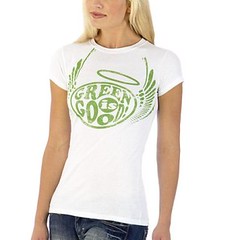
What gets me is that the claim to caring for the environment is printed using conventional toxic dyes on a shirt made of conventional cotton. Tons of environmentally unfriendly chemicals and pesticides were dumped into the environment to create the opportunity for trendy teens to expresses (boldly across their breasts) their deep commitment to caring for the environment. Did they ever stop to think?
Then in further environmental news - I was at Trader Joe's and of course had forgotten my nice reusable canvas bags yet once again. At the check out I asked the guy to not waste bags since I would just be transferring the food to the cooler in my car. He got really confused and didn't know what to do with my food. I asked him to just put it all back in the cart. At that point he said, "how about I just put it all in plastic bags." Because it is so common to not want to waste paper bags so that you can use plastic ones instead! I gave up and he packed it all in paper bags.
And finally in the "does this disturb you as much as it did me?" category, I saw this bumper sticker -

No wonder the world hates us. How can we continue to pretend that we are a "Christian" nation if this is our foreign policy? Forget loving your enemies, forget "forgive us our trespasses as we forgive those who trespass against us," who needs crap like that when we have a license to kill?
Anyway, can you tell I'm having a "what is this world smoking?" sort of day?
Labels: Culture, Environment, rants
To comment on one small aspect of the book - the general complaint that to eat ethically (or healthy for that matter) is just too expensive. The average person can't afford to be ethical excuse. Here are a few quotes from the book that put that into perspective -
"The cult of low prices has become so ingrained in the consumer culture that the deep discounts are no longer novelties. They are entitlements. Bargain-seeking seems to be such a basic aspect of human nature that to question it can appear quixotic. But... the bargains hide costs to taxpayers, the community, the animals, and the environment."
"Organic food costs more partly because ... intensive industrial agriculture leaves others to pay the hidden costs of cheap production - the neighbors who can no longer enjoy being outside in their yard; the children who cannot safely swim in the local streams; the farm workers who get ill from the pesticides they apply; the confined animals denied all semblance of a life that is normal and suitable for their species; the fish who die in the polluted streams and coastal waters (and the people who previously caught and ate those fish); and the unknown numbers of low-lying lands in Bangladesh or Egypt who will be made homeless by rising sea levels caused by global warming. It is understandable that people on low incomes should seek to stretch their dollars by buying the lowest-priced food, but when we look at the larger picture, the food produced by factory farming is not really cheap at all."
"Americans spend far less of their income on food than people in other countries ... we spend a smaller proportion of our income on food now than we used to - on average, only 6 percent of our total income goes toward buying groceries, down from 17 percent fifty years ago. In fact, we probably work for fewer hours to feed ourselves than people have anywhere, in all the millennia of human existence... if Americans want to eat better quality food, most of them have the means to pay for it."
"The price of food should reflect the full cost of its production. Then consumers can choose whether they want to pay that price. If no one does, the market will ensure that the item ceases to be produced. Meanwhile, if the method of producing food imposes significant costs on others without their consent - for example, by emitting odors that make it impossible for neighbors to enjoy living in their homes - then the market has not been operating efficiently and the outcome is unfair to those who are disadvantaged. The food will only be cheap because others are paying part of the costs - unwillingly. Any form of food production that is not environmentally sustainable will be unfair in this respect, since it will make future generations worse off."
Someone somewhere is paying the cost for low price. If we care about being ethical (instead of just saying screw you), we have to be willing to pay a fair price for our food. That may mean getting over our sense of entitlement to a certain lifestyle (meat at every meal, or even everyday) in order to afford better food. And it isn't just about passing the costs on to others, they do eventually catch up to people. Tax dollars that go to cleaning rivers, insurance costs that rise as more people get sick from the toxins used to produce our food. For example, I personally have spent thousands of dollars this past year (above insurance) to figure out what is making me ill (I have had a constant swollen throat for 7+ months). Having gone through the "it might be cancer" or it "might be this" tests, the thought is that since moving to a rural area, I have developed chronic allergies to the massive amounts of pesticides and fertilizers I am surrounded with. I am constantly sick so that cheap corn can be grown so Americans can eat more crap full of high fructose corn syrup. And I am just one small example of the collateral damage of cheap food where the full cost isn't assumed by the producer or the consumer but is passed on to others. Can we really be ethical and continue to do that?
Labels: Environment, Social Justice
 If you are at all aware of the news or have children and have received emails from 50 different friends about it, you have heard about the recent recall by Fisher-Price and Mattel of over 1 million toys due to excessive lead content. Then today the Chicago Tribune reported on some toys that are just now being recalled even though the company has known for over 5 years that the lead content in them was 40 times the safe limit. I looked at the Fisher-Price list, given that most of the toys on there are Sesame Street and Dora toys, we own a number of the ones on it. But since we got them all before May 1, 2007, they are apparently perfectly safe. Sure, whatever.
One of the most common responses to my recent justice bra story was that it was absurd for me to care about chemicals used to make my clothing. The comments ranged from stating gross misconceptions like if we don't use fertilizers and pesticides people will starve to the old adage that everything causes cancer so why bother caring. The everyday exposure to dangerous chemicals has become so accepted that people no longer care. We expect it to be plastered all over the news if really dangerous stuff (lead in our child's Elmo karaoke machine) gets out. Then there will be an outcry, a full recall, and we can all be safe. No need to worry, no need to care. But as the book Fast Food Nation pointed out, just because there are no reports of danger does not mean the danger doesn't exist just that they aren't bothering to test for it. Which is what gives me so much confidence that our copious Elmo and Dora toys are "perfectly safe."
But how does one proceed? I don't think that I'm going to throw away Emma's favorite toys. And I know that there are tons of other unhealthy items in my home - toys and otherwise. But I am also not a fan of the type attitude that states, "well everything causes cancer (or whatever), so why waste your time caring?" If "everything" is harmful why in the world would I just want to expose myself (or my child) to as much of it as possible? Wouldn't it be smarter to avoid what can be avoided and advocate to reduce the use of poisons in other areas? There are alternatives and contrary to popular belief those alternatives aren't that hard to find (or that much more expensive). So perhaps getting rid of everything one already owns isn't the best response, but changing one's habits from this point forward is. It just takes being willing to stop exposing oneself to poison. But as I am discovering, that isn't something that most people are willing to do. It's too much work or something like that.
Labels: Environment, parenting, Social Justice
Most simply because it was true. It was a true story based on the fact that I really needed a new bra, but it became amusing because of the oddity of writing about a bra. I expected people to smile at the situation and move on. But that proved too difficult for some. Apparently there are a lot of men out there who have the maturity level of a junior high boy when the subject of women and their bodies is brought up (no offense to jr. high boys intended...). Bras are for breasts and the only purpose of those is for sex - or so some seem to believe.
I think I should clarify before I go much further. I have issues with the way the secular media and the Christian church have oversexualized the female body. Of course the body has sexual aspects, but that is a limited and not holistic view. Our bodies are wonderful creations that should be appreciated and cared for. Too often we see them only as shells to be starved and carved into cultural definitions of sexual attractiveness. If the natural functionings of the body don't aid our sexiness, we hide (or seek to eliminate) them. As discussed recently over at Emerging Women, our menstrual cycles have become a thing to be feared and despised rather than celebrated and accepted. Same thing with breasts. They have become so associated with being a sex object that their natural function for breastfeeding has become taboo for many. Hence the issue with bras. For me a bra is just a part of everyday life. Oh, yes, they can serve a sexually charged function, but as one of the basic everyday parts of life I found it appropriate to see if I could bring environmental stewardship and ethical consumption into that area of my life.
But as a few of the reactions to the story demonstrate, there are some who do not think such a thing is possible. Oh there were those who resorted to cleavage and support jokes - lighthearted attempts to deal with the uncomfortable, but there were others who assumed that I could not possibly be serious about justice issues because I was talking about a bra. Some went so far as to claim that I was a right-wing critic who must be making fun of people who care about justice since I dared to talk about bras. Apparently anything remotely sexual cannot be taken seriously. (which is kinda the whole problem with women only been seen as sex objects and therefore not being taken seriously...).
The point of my search for a justice bra was to see if I could live holistically. To see if I could care for the environment, care for the poor and the oppressed, and be a conscientious consumer. Doing such things requires one to be aware - to consider where and how plants are grown, to think about the long term impact of dyes on the environment and our health, to care for the people who had to work with those chemicals or make my clothes. Our food and clothing does not magically appear in the stores - it all has a story, often a tragic and painful story. Being aware of that story and seeking to improve it is just part of what it means for me to let Christian values influence all areas of my life. But I also see living holistically to include accepting and being comfortable with my body. To care for its needs and not to fear the parts that men have defined in ways that divorce them from their natural function. I do not want to clothe myself with harmful chemicals or dump unnatural hormones into my system. I also don't want my body to be commoditized by men who think it is only useful as a sex object. So I will not shy away from discussing natural and normal aspects of life. And that includes bras.
Labels: Culture, Environment, Personal, Social Justice
Brief history here. Very, very brief. The British Empire colonized what is now Nigeria and often used force to do so. They eventually formed Nigeria from pieces of four independent kingdoms. After Nigeria gained independence, the remains of those ancient tribes vied for power and survival. Series of dictators made themselves rich by selling land belonging to other tribes but with new found oil reserves to large multinational companies. These companies (Shall, Chevron) were known to support the military regimes of these dictators and are implicated in the deaths of activists who opposed the path being taken by their country. These oil companies devastated natural environments and often (with government help) imposed forced relocations of native peoples off of oil rich lands. In the 1990's protest groups formed to speak out against the rape of the land by the oil companies. The native tribes wanted to continue in their way of life, but their fishing economy was ruined by pollution or they were forced to move to land with poor soil. They also received no wealth from the oil taken from their native lands. Early protest was peaceful and focused on diplomacy and discussion. Much of it was led by women as well. It was generally met with violence. Then more militant groups formed that used violence to end the control of the land by the oil companies. Kidnappings of oil executives involved ransom demands - so that the people of Nigeria could share in the wealth taken from their lands. Then there were bombs to destroy pipelines and cripple the multinational companies. This is the story that this kidnapping is situated in. I don't condone the violence of that act just like I don't condone the violence perpetrated by the oil companies or the dictators or the British Empire - I just want the full story told. Everything is connected as the saying goes. This event must be understood as part of a long chain of events. Perhaps then the cycles of violence can end and a better world be formed.
We are discussing this issue in church today as we examine the Parable of the Tenants and the life of Samson. In those stories we see the ugly cycles of unbroken violence. One offense is met with violence which leads to more violence and so forth. Excuses are given and revenge is demanded. It is an ingrained concept in our culture. We cheer in movies like Braveheart or The Patriot when revenge is consummated. We care less about the defeat of evil than we do about extracting punishment on someone who has hurt or offended us. And we care even less about trying to resolve differences without resorting to violence. Our imaginations are so limited and our hatred so strong that to hurt others far too often is the first and only response. Cycles are hard to break. And often those who seek a better way are silenced with violence. Christ warned his followers that they could expect as much, but still urged them to pursue the way of peace. Perhaps if his followers had listened to his words a couple hundred years ago as colonization of Nigeria began or fifty years ago when oil was discovered there, a little three year old girl would not be in such dire circumstances right now.
Update - Margaret has been released
Labels: Culture, Environment, Politics, Social Justice
 Sometimes it feels like the universe is conspiring to teach me something. When by seeming coincidence a certain idea presents itself to me in various forms over a short period of time. A call to consideration that if I claim to even pretend to be self aware I can't ignore. That's what happened this past week. In one form or another, I encountered the themes of faith, place, and longing. The idea that we are connected in some way to the land and that there are places in this world that resonate strongly with us - sacred places as it were. Or at least that we all suffer from a sort of "global homesickness" - the results of the disconnects present in modern society which leave us all longing for home.
It started this past week as I read Anne Bishop's novel Belladonna, the second book in her Ephemera series. It is a fantasy novel about a world where one must resonate with a particular landscape in order to live in harmony there. Being forced into landscapes not of one's heart leads to dissonance, depression, and destruction of the Light. People know intuitively what landscapes they resonate with because they feel content and whole in them - they feel at home. So as I read about resonating with the land I traveled to the beautiful woods of Northern Michigan. I found myself among family and towns that seems to share similar passions as I. So with this vague conception of connecting with the land playing through my mind, we drove the 7 hours home and by sheer coincidence ended up listening to two podcasts on that very topic. The first was Rob Bell's "Wine and Heaven" sermon (available for free download for a few more weeks here). It is an amazing sermon well worth listening to that covered a lot of ground, but in it he mentions how we have lost our connection to the earth. How we must go on vacations to get outside and be reconnected with nature (and each other). So with those words in mind we then selected to play a NPR podcast of Speaking of Faith with Krista Tippett about Pagans Ancient and Modern which brought all those themes together. The program interviewed Adrian Ivakhiv, an environmentalist at the University of Vermont and a scholar of Paganism. Who "was first drawn to Pagan literature because of its strong emphasis on ecology, the natural world, and a sense of place. He's studied how ancient Pagan ideas are woven together in Western culture and even mainstream religion. He describes a fascinating connection between magic and meaning, and between sacred landscapes and what he calls "our global condition of homesickness."
Our global condition of homesickness. A desire to reconnect and resonate with place. The idea that there is something mystical or even magical that calls us to certain places - some that we sense are sacred, others that just feel like that's where we are meant to be. I understand that desire, I feel that need to be at home. A few years ago if I had encountered such ideas, I would have immediately assumed them to be examples of what C.s. Lewis described as sehnsucht - a deep "inconsolable longing" in the human heart for "we know not what." As he put it (and then fleshed out in his famous sermon The Weight of Glory), "If I find in myself a desire which no experience in this world can satisfy, the most probable explanation is that I was made for another world."
But I don't know if I agree with that anymore (or at least the common interpretation of it that I've been taught). I know its generally considered heresy for a Wheaton alum to question the wisdom of St. Jack, but I no longer believe that our hope is in a pie in the sky when we die sort of scenario. I'm not sure that's what Lewis was intending, but that it most assuredly how evangelicals have co-opted his words (just read John Eldredge). But our hope is not in escaping to Heaven, but in the bodily Resurrection and a New Earth (and yes I see the significance of "new" there). So, I wonder, how can we say that we are completely in exile here or that this earth is not our home? Beyond the environmental disasters such theology has permitted, it has also led to our disconnect from the land. We no longer live in the places we resonate with and long to return home (whatever that may mean). So what if the answer to that homesickness isn't some gnostic escape hatch theology, but a need to see the truth that the "pagans" have clung to all along - that we can resonate with creation, find God in the Sacred (thin) places, and actually feel at home? Or some blessed balance of both?
I want to explore this more, I need to explore it more. I have no answers just many many questions as once again assumptions I had about the nature of the universe are clouded with doubt. My journey into the emerging church conversation has led to many such questions and I appreciate the challenge to seek understanding as unsettling as it can sometimes be. I would love to hear other's thoughts on this as I work my way through it.
Labels: Environment, Personal, Reflections, Theology
 On Sunday morning this past weekend at the Jubilee conference we got to "worship" with spoken word protest poetry (you can find some of it here). One line that really struck me was, "our arms are raised, but our fists are open." We raise our hands in worship, a symbol of our close connection to God and the depth of our personal piety, and yet we don't raise our fists in protest of the injustices in the world. We are too lazy, too wrapped up in church events, or too afraid to get involved. Our "worship" is all about us and not about others. I am reminded of the passages from Isaiah where we're told the kind of worship God desires -
Isaiah 1:15-17
When you spread out your hands in prayer,
I will hide my eyes from you;
even if you offer many prayers,
I will not listen.
Your hands are full of blood;
wash and make yourselves clean.
Take your evil deeds
out of my sight!
Stop doing wrong,
learn to do right!
Seek justice,
encourage the oppressed.
Defend the cause of the fatherless,
plead the case of the widow.
Isaiah 58:6
This is the kind of fast day I'm after:
to break the chains of injustice,
get rid of exploitation in the workplace,
free the oppressed,
cancel debts.
So while I am encouraged that the Emerging Church is becoming more and more aware of these issues, universal action still seems a long way off. I still encounter people who debate whether not not we should attempt to right the wrongs of the world. Or those that tell us not to get bogged down on the big issues, just focus on your everyday life. Or those who say all we need to do is pray and not have anything to do with politics ever. My response is that we need to get up off our knees and put our prayers into action. But how do we motivate people? Why should people care?
In a session this weekend one presenter listed the reasons why people should care about Debt Relief. I find these interesting and wonder if there are any more that can be added to the list.
- It's a moral issue and as people of faith/conscious we should care for others. We should be moved to effect change and love our neighbor. But if that isn't enough to motivate us, there are a few other reasons -
- Health concerns. If indebted countries continue to slash funds to heath services so that they can repay debt, disease will flourish. There has already been a significant rise in easily treatable/preventable diseases as a direct result of the reduction in doctors, nurses, and clinics. But there is also the potential (and we are seeing the beginnings of it) for deadly diseases to proliferate which will effect the whole world. If other countries can't handle epidemics of TB, Avian flu, and AIDS the whole world will pay.
- Environmental degradation. As countries that are forced to spend 80% of their budget on debt repayment scramble to find alternate sources of income, the environment is laid waste. Forests are clear cut, unsustainable crops are planted, pesticides are dumped into the environment, chemicals are dumped into rivers instead of disposed of properly. This destroys ecosystems and will result in a completely unlivable landscape down the road. Where will all the people go then or whose aid will they live on then?
- To get the politicians (the ones in the position to affect change - i.e. clean up the messes they have made) to care, it takes the voters letting them know that care care. If the politicians know that they will face consequences if they don't listen to their constituency, then they will work for change in order to save their own butts come election time.
What could you add to the list? Is it bad to focus on the natural consequences that will effect us personally if the plight of the other isn't enough to move us to action? I would love to hear your thoughts.
Labels: Culture, Emerging Church, Environment, Social Justice

I have spent a very large amount of time this past week surfing the web for sites on ethical consumption. I'm writing a separate piece about the why behind all that, but it has been an interesting adventure. And I've found a lot of really cool sites.
What is ethical consumption you might ask. It starts with me the consumer admitting that while I want to avoid rampant materialism, I am not going to be one of those people who move off the grid and have a zero impact year or something (as my last post explored, for most of us ethical living can't be an all or nothing approach). I will need to buy stuff from time to time. So given that, I want to do so ethically. That means I ask the hard questions - where has this come from? what is its past, present, and future effect on the environment? is it harmful to my physical or psychological health? and were the people who made it treated humanely and paid a fair wage at all stages of the process? It is a lot of stuff to weigh as one makes a purchasing decision and it is a lot harder than the culture of convenience we are used to.
There are many people who think that ethical consumption is not only hard, but that it is impossible economically. That to buy with one's values contradicts the laws of economics. That's why the t-shirt displayed above made me laugh as I stumbled across it this past week. My thoughts - One - do the "laws of economics" really matter in light of environmental chaos and injustice? Are people really so callous to favor economic theory above creation care and human rights? (don't answer that...) and Two - in the law of supply and demand it is the consumer who creates the demand. We demand that we want ethical options (environmentally sustainable, healthy, and fairly traded) and the supply will increase. But it takes us actually doing it, being ethical consumers not just blogging idealists, for that to happen.
One of the cool sites that I discovered this past week that helps make it happen is the New American Dream. They are a great resource site for living ethically. The new dream is to live consciously (feel more alive and aligned with your values), buy wisely (use your power as a consumer to create change) and make a difference (let your actions speak for themselves - then speak up anyways). I'm going to have fun exploring their site and using their resources.
Ways to shop ethically are out there, sometimes it just takes a lot of time and effort to find them. I'm toying with the idea of trying to start a blog or something where people can pool resources about stuff like this. A place to review products, share shopping links, give environmental research updates and other fun stuff. What do you think? Worthwhile? Doable? Wanna help?
Labels: Culture, Environment, Social Justice
This new series looks at contemporary American culture through the austere lens of statistics. Each image portrays a specific quantity of something: fifteen million sheets of office paper (five minutes of paper use); 106,000 aluminum cans (thirty seconds of can consumption) and so on. My hope is that images representing these quantities might have a different effect than the raw numbers alone, such as we find daily in articles and books. Statistics can feel abstract and anesthetizing, making it difficult to connect with and make meaning of 3.6 million SUV sales in one year, for example, or 2.3 million Americans in prison, or 426,000 cell phones retired every day. This project visually examines these vast and bizarre measures of our society, in large intricately detailed prints assembled from thousands of smaller photographs.
The art is stunning and the numbers are scary. It truly is a portrait of our consumption and waste. Hopefully a visual image of the aftereffects of our actions will cause us to stop and think every now and then. Here are a few of the images. They are hard to get the sense of in the small jpeg forms. On the site you can see the full image as well as partial and actual size zooms.
Plastic Bottles - Depicts two million plastic beverage bottles, the number used in the US every five minutes.(zoomed)

Cell Phones -
Depicts 426,000 cell phones, equal to the number of cell phones retired in the US every day. (zoomed)

Plastic Bags - Depicts 60,000 plastic bags, the number used in the US every five seconds.

Labels: Culture, Environment
green LA girl - the adventures of trying to live justly in LA. I enjoy all the stories of environmentally friendly practices. She reviews companies and coffee shops in her attempts to discover how to exist without harming the world and other people. Its fun to read and a fantastic resource. She does all the research on where to find organic fairly traded items (you can get fairly traded underwear???). Anyway I highly recommend you check it out.
Then I discovered Change Everything a group site for people in Vancouver, Victoria and the Lower Mainland who want to change themselves, their communities or their world. I enjoy reading the blogs about the everyday attempts people are making to try to make this world a better place. My favorite so far is EnviroWoman's Living Plastic Free in 2007 journal. She is chronicling her attempt to bring no new plastic into her life for one year. The writing is witty and I don't think I've enjoyed reading about trash this much ever. (check out her entry about having to give up her love affair with frozen pizza). I'm discovering some random facts as well - did you know that the insides of Pepsi cans are coated with plastic (apparently its so acidic that it would eat through the can otherwise)? It made me realize how just about everything I buy has plastic in it. Not only does that do a lot to hurt the environment (in production as well as landfill junk) but the reports of toxins and carcinogens related to plastics just keep coming in. So I see the rationale behind this project, but the first thing I thought after I really started evaluating my plastic consumption was - "wow, she must not have kids." Everything for kids is made of plastic (is it even possible to find non-plastic sippy cups?). I honestly don't know how anyone with kids could ever do something like this, but I do admire her attempt.
If you can't tell, I like stories. Stories of people out here actually doing stuff to change the world. The more everyday and ordinary, the more helpful I am finding it.
So does anyone else have stories they can share? Everyday ways you (or someone you know) have deliberately changed the way you live in order to make this world a better place?
Labels: Environment
I'd like to build the world a home
And furnish it with love
Grow apple trees and honey bees and snow-white turtle doves
 Sorry for the 70's flashback there. Emma's favorite toy of the moment is a music box that plays that song (it was mine when I was a baby). Anyway she is very insistent on "mommy sing" and so after singing "I'd like to teach the world to sing" for the bazillionth time this afternoon, the current irony of those lyrics struck me.
Grow apple trees and honey bees. Well it is highly likely that the way we have been growing our apple trees (and other crops) is killing off the honey bees. I've been following the headlines recently about the Colony Collapse Disorder that is wiping out bee hives around the world. Since last fall about a quarter of the bee hives have just disappeared (in some areas up to 90%). The bees are rejecting the hives and dying away from home. And this is serious to our agriculture. The pollination by bees is a 15 billion dollar industry. Most of the most nutritious and healthy superfoods we eat are dependent on bee pollination. Besides producing honey, commercial beehives are used to pollinate a third of the country's agricultural crops, including apples, peaches, pears, nectarines, cherries, strawberries and pumpkins. Ninety percent of California's almond crop is dependent on bees, and a loss of commercial hives could be devastating.
No one is really quite for sure as to what is causing this sudden drop in bees. It is far worse than any past decline and is different than disease or parasites that have hurt bees before. There of course has been speculation as to the cause.
Some speculate about pesticides and genetically modifies crops (crops that have pesticides built into their make-up - yummy). The bees are leaving the hives to die and predators that would normally scavenge empty hives are leaving them alone. This implies the presence of a chemical(s) that the other insects and animals are instinctively smart enough not to touch. Certain new nicotine based pesticides (yummy again) prevent the bees from forming and keeping memories. So they go out and feed on this stuff (which was originally meant to treat seeds but is now being SPRAYED on crops) and can’t remember how to get home. And it also causes their immune systems to collapse, causing what would be normal organisms to become pathogenic to the bees. Others wonder about the cumulative affects of pesticides. While each individual pesticide might get labeled as "safe and acceptable" there is little research being done on the cumulative harm. One pesticide by itself might not destroy honey bees. But what happens when farmers spray herbicides, fungicides, insecticides and rodenticides on land that also has genetically modified crops with pesticides built-in? (wow this is really making me feel great about the food I eat...)
Others speculate that this problem is caused by a fungus or parasite or just a strange combination of unsustainable farming practices with some new disease. And then there are those who blame cell phones The issue is currently being investigated by the US House Agriculture Committee.
So to throw in the quote that everyone has been quoting - Albert Einstein speculated that "If the bee disappeared off the surface of the globe, then man would only have four years of life left." Dire commercial ruin for bee keepers. Devastated crops. Food shortages and price hikes. All because our worship at the alter of the almighty dollar doesn't permit sustainable food practices?
Maybe there's something to that growing apple trees and honey bees in perfect harmony idea...
Labels: Environment
WASHINGTON (AP) -- Global warming poses a "serious threat to America's national security" and the U.S. likely will be dragged into fights over water and other shortages, top retired military leaders warn in a new report.
The report says that in the next 30 to 40 years there will be wars over water, increased hunger instability from worsening disease and rising sea levels and global warming-induced refugees. "The chaos that results can be an incubator of civil strife, genocide and the growth of terrorism," the 35-page report predicts.
Read the full story here
Labels: Environment, Social Justice
The BBC has run a great article detailing how global warming has already started to change the world. Read it here.
The facts about how a climate change as small as 1-1.5 degrees will have major impacts on the world reminds me of that scene from Jesus Camp where that homeschooling mom was ridiculing and teaching her boys the utter falsehood of global warming because a couple of degrees is nothing. But as one could tell from the rest of the lesson, they really didn't care much for science or facts.
What I don't get is how people can be so sold to a political party that denies global warming for political reasons that they ignore the threat that people may die because they have no water.
Labels: Environment, Politics
 Last night our church helped sponsor a Faith and the Environment forum. This was the second Faith and Politics forum we have been involved in. The first was about immigration and it's a chance to bring together area churches for a discussion on how our faith relates to these issues. This event was part of the Kendall Environmental Coalition's series of activities to help heighten environmental awareness in our area. Last night we met at the Yorkville congregational Church (which Emma decided was a castle). There were three "experts" that Mike asked a series of questions and who then accepted questions from the group. The presenters from around the Chicago area included Dr. Jeff Greenberg, a geology professor at Wheaton College; David Radcliff of the New Community Project; and Sarah Spoonheim from Faith in Place. They were a fantastic group to speak on the issues of faith and our environment. I want to find out more about their organizations as well.
They spent time discussing why environmentalism is a faith/moral issue. For many of them it went beyond God's command to be good stewards of our earth. They focused on Jesus' command to love and serve the least of these - to help the poor and oppressed. They explained how already the harm being done to our world hurts the poorest in the world the worst. Inuit women whose breastmilk is full of toxins because of the pollution of the rest of the world, the Africans who are starving because of how climate change has destroyed their ecosystem, the farmers who are exposed to toxins so they can grow our food for 8,000 a year, and the poor who live along the world's coasts that will take the brunt of the superstorms and rising oceans. If we are to follow Jesus' command to love others, we have to take care of the world as well.
There was also discussion as to why people (and most Christians) don't care about the environment. Reasons such as a twisted dispensational theology, a separatist theology that sees the "world" as including the physical planet, a conception that it distracts from more important things like getting people to say the Sinner's Prayer, a tendency to avoid associating with people who are different from them (like Al Gore!) and a belief that God will never let us really hurt the world were all reasons that were discussed. But most of the presenters agreed that Christians, like most Westerners, ignore the environment because of laziness, economics, and politics. We are too lazy to change, we are too cheap to change, we are too in the pockets of big business to change, and we care more for a political agenda than we do God's commands to change. These are the hurdles that need to be overcome before we can mobilize churches to follow Christ in this area.
One issue that hit home for me was that of food. The techniques of raising our meat and getting our food to us do a lot to hurt our environment. The mass cattle farms do more to harm the environment than our transportation does. So buying food that comes from places that care for the world and those animals helps reduce that impact. But the issue is held in tension with other harmful practices. If I have to drive an hour (use gas, create CO2) to get to the closest Whole Foods to get organic meat is the impact worth it? Or is creating the demand for healthy, environmentally friendly foods worth it? The idea is of course to buy as locally as possible. We buy a share in a local CSA farm during the growing season, but haven't done much meatwise. I did get the tip last night to check out Eat Wild for local organic meat - so does anyone want to go in ($2000) to buy a whole cow?
As a take away from the evening I realized that the issues were a lot bigger and more complex than I had thought. There is a lot more that I need to do to care for God's creation, but that my motivation shouldn't be guilt or fear, but hope for a better world.
Labels: Environment, Politics, Social Justice